
US Housing: A Tale of Two Markets
US Housing: A Tale of Two Markets
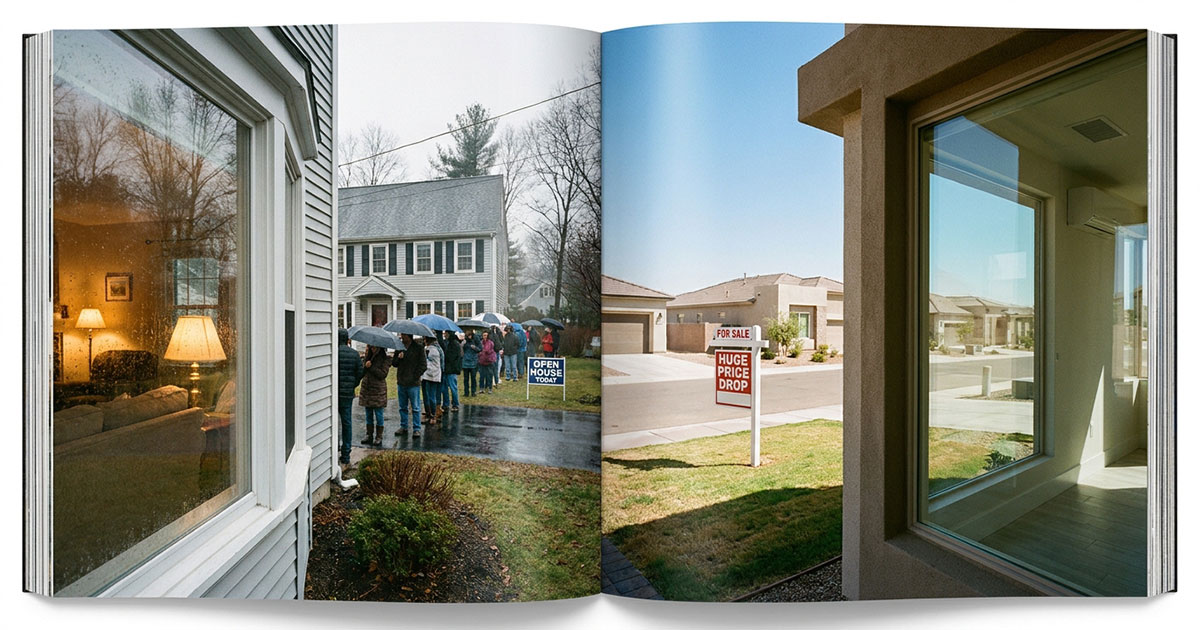
The United States housing market is experiencing a profound geographic divergence, meaning that national real estate headlines often mislead buyers and sellers. While tight inventory drives up prices across the Northeast and Midwest, a massive surge in new construction and rising insurance costs on the Southern Sun Belt have triggered noticeable price corrections.
The Illusion of a Single American Housing Market
When major financial news outlets report on the state of American real estate, they almost exclusively rely on nationwide aggregate data. Consumers routinely read headlines declaring that home prices across the United States have stabilized, fallen by a slight percentage, or reached a historic plateau. However, this generalized approach completely obscures a historic geographic fragmentation that makes national statistics practically useless for individual decision-making. The reality is that there is no singular American housing market anymore. Instead, the country has fractured into distinct regional micro-markets that are moving in completely opposite directions due to unique localized economic forces. Relying on a national average to price a home in Massachusetts or negotiate an offer in Texas is equivalent to checking the average temperature of the entire North American continent to decide what clothes to wear in Chicago. Today, the forces driving real estate are hyper-local, and understanding these regional disparities is the only way for buyers and sellers to navigate the current landscape without making costly financial errors.
The Resilient and Stagnant Northeast and Midwest
In the northeastern and midwestern regions of the country, the housing market remains locked in a fierce, competitive environment that favors sellers. Metro areas such as Boston, Newark, Chicago, and Grand Rapids are seeing consistent price appreciation and intense bidding wars. The primary driver behind this resilience is a severe and chronic shortage of available housing stock. Homeowners in these older, established regions are largely holding onto their properties, reluctant to give up the historically low mortgage rates they secured years ago. Because land is scarce and local zoning laws are notoriously restrictive, homebuilders cannot easily construct new developments to meet the demand. As a result, even though current mortgage interest rates remain elevated, the sheer scarcity of homes forces motivated buyers to compete aggressively for a limited pool of listings. Properties in these markets are selling rapidly, often within a couple of weeks of hitting the market, proving that regional economic stability and structural inventory deficits can easily override the chilling effect of higher borrowing costs.
The Great Correction Across the Southern Sun Belt
A completely contrary dynamic is unfolding across the Southern Sun Belt, a region that includes states like Texas and Florida. Markets that experienced an unprecedented boom during the pandemic, such as Austin, Miami, and Cape Coral, are now undergoing a significant and visible market correction. This shift is primarily driven by a massive wave of new residential construction that has finally caught up with and surpassed consumer demand. Homebuilders in the South face fewer zoning restrictions and have access to vast tracts of developable land, allowing them to flood the market with new single-family homes and townhouses. Consequently, active listings have surged to their highest levels in years, giving buyers an unprecedented amount of leverage. Compounding this influx of inventory is a quiet crisis regarding homeownership costs, particularly skyrocketing property insurance premiums and rising local property taxes. As insurance companies raise rates or pull out of coastal states entirely, the total monthly cost of owning a home has become prohibitive for many, forcing sellers to slash their asking prices and leave homes sitting on the market for months.
Decoding the Metrics That Matter for Consumers
Because aggregate national data fails to capture these massive regional swings, both buyers and sellers must learn to track localized real estate metrics to understand their true market reality. The most crucial metric to observe right now is the local Days on Market, which measures how long a home sits empty before a contract is signed. If the average time on the market in a specific ZIP code is climbing past forty-five days, it signals that buyers have gained the upper hand and can aggressively negotiate for price cuts, repair credits, or mortgage rate buy-downs. Conversely, if homes are still selling in under twenty days, buyers must expect to pay full asking price or more. Another vital indicator is the local inventory volume compared to previous years. When local active listings increase by double digits, it serves as a warning to sellers that they can no longer utilize aggressive pricing strategies. True real estate literacy in the current economic climate requires ignoring the national media noise and focusing entirely on the neighborhood level, where supply and demand are actually balanced.
Strategic Navigating of a Fragmented Reality
Navigating this deeply divided market requires entirely different strategies depending on where a consumer is located in the country. Sellers in inventory-starved regions like the Northeast can still afford to be confident, but they must avoid the trap of overpricing, as modern buyers are highly sensitive to high mortgage rates and will reject homes that require immediate, expensive renovations. For sellers in the Sun Belt, the strategy must pivot toward extreme flexibility, which means offering concessions such as closing cost credits or buying down the buyer’s interest rate rather than holding out for an unrealistic peak price. Buyers, on the other hand, should look at this regional split as an opportunity to find hidden value. A buyer willing to relocate to or invest in the correcting Southern markets can secure significant discounts and take their time choosing a property without the stress of a bidding war. Ultimately, success in this fractured real estate environment belongs to those who recognize that all real estate is local, allowing localized data to guide their financial expectations.
Jack C Bharat
Minority-Owned Business Enterprise (MBE) Certified with NYC
122-15 111th Avenue, S Ozone Park, NY 11420
Email: jackcbharat@gmail.com
Phone: (718) 805-6982
Jack C Bharat has been in the Real Estate Business since 2003. As a Realtor & Developer, his experience in buying dated, distress or fixer upper and renovated them back for resale can help both buyers and sellers in their transactions. Graduated in 1999 from Queens College (CUNY) Flushing, with a Bachelors Degree and in 2012 from LaGuardia College with Goldman Sachs 10K Small Business Certificate Of Entrepreneurship, Mr Bharat is always educating himself to stay current and sometimes ahead of Real Estate Market Trends. He is currently a Notary Public in the State of NY as well. Mr Bharat has completed real estate projects in NY-Queens & Long Island, Florida-Ocala & Coral Springs & recently Providence Guyana (2023) 8units apt residential and currently working on a Mix Use 3 Story Commercial Building on Moca & Heroes Hwy @ Providence Guyana. His passion for creating projects that blends functional modern architectural design in harmony with the natural environment are evident in all his projects. Mr Bharat is also the CEO of Liberty Office Supplies & Equipment, Inc. A Certified Minority Business Enterprise (MBE) with NYC & NYS. Est in May 1999, Liberty provides a wide range of office supplies and works as a sourcing company for the Federal Govt by being a GSA Schedule MAS Holder.
Jack is Licensed as a Real Estate Broker in State of New York and in the State of Florida. He has knowledge in both residential and commercial sales. His motto “Working with Clients to achieve their real estate goals” is what drive him to be on top of his game”. He is very involved in his community especially with social and educational issues. He is the proud sponsor of a local Cricket Team, Boxing and donates his time and money to various organizations that work with children, abuse victims and the elderly. He is a member of the Jamaica Rotary Club & The Free Mason Lodge of NY. He is cited by NYC Mayor’s Office, NYS Assembly and NYC Council for his leadership role in his community.
Mr Bharat has three daughters: Alicia who graduated with her Masters Of Science in Education from Queens College and is now a STEM Teacher with the NYC Dept of Education & a second Masters in Public Admin in May 2026, Kayla who has graduated (2024) from CUNY School for Public Health with her Masters of Public Health in Environmental & Occupational Health Sciences & works as an Environmental Health & Safety Specialist with Sloan Kettering Cancer Ctr. and Jessica recently graduated (2025) from Queens College and currently pursing her goals in the Dental Field.
Jack is Licensed as a Real Estate Broker in State of New York and in the State of Florida. He has knowledge in both residential and commercial sales. His motto “Working with Clients to achieve their real estate goals” is what drive him to be on top of his game”. He is very involved in his community especially with social and educational issues. He is the proud sponsor of a local Cricket Team, Boxing and donates his time and money to various organizations that work with children, abuse victims and the elderly. He is a member of the Jamaica Rotary Club & The Free Mason Lodge of NY. He is cited by NYC Mayor’s Office, NYS Assembly and NYC Council for his leadership role in his community.
Mr Bharat has three daughters: Alicia who graduated with her Masters Of Science in Education from Queens College and is now a STEM Teacher with the NYC Dept of Education & a second Masters in Public Admin in May 2026, Kayla who has graduated (2024) from CUNY School for Public Health with her Masters of Public Health in Environmental & Occupational Health Sciences & works as an Environmental Health & Safety Specialist with Sloan Kettering Cancer Ctr. and Jessica recently graduated (2025) from Queens College and currently pursing her goals in the Dental Field.